
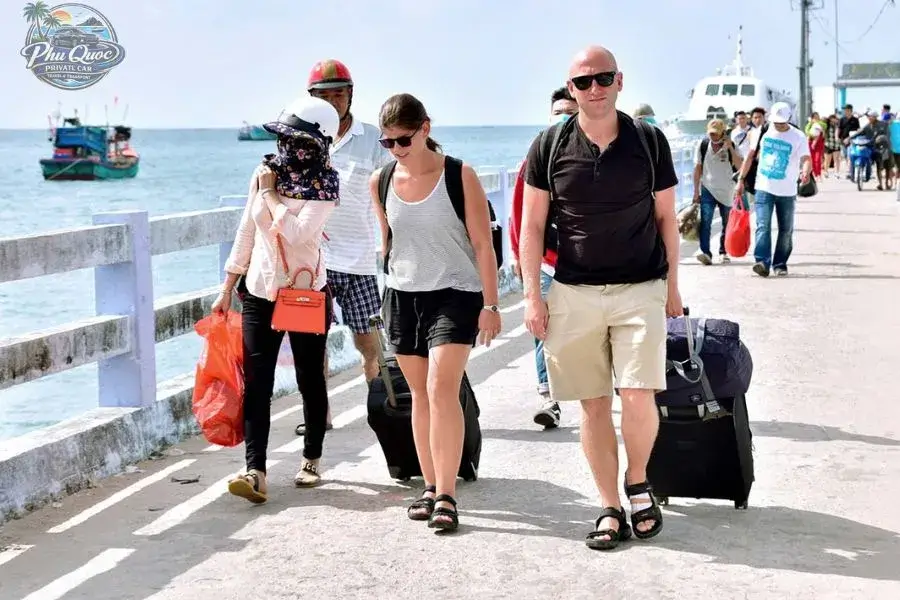
Introduction
Whether you are looking up how to get to Phu Quoc from Ho Chi Minh for a luxury getaway or mapping out a slow-paced overland adventure, your decision hinges on a classic trade-off: saving precious time or sticking to a lean budget.
As you may know, Phu Quoc has evolved from a sleepy Gulf of Thailand outpost into Vietnam’s premier island escape. It sits closer to the Cambodian coastline than mainland Vietnam. However, making the journey down from Saigon is smooth, highly accessible, and straightforward, provided you understand the local transportation infrastructure.
This master guide breaks down the real operational hours, actual costs, and boots-on-the-ground logistics to ensure you navigate the route safely, comfortably, and like an insider.
Quick Answer: Choosing Your Route in 30 Seconds
For rapid planning, the choice between booking a flight or riding down through the Mekong Delta can be weighed using these realistic operational parameters:
| Transport Mode | Total Door-to-Door Time | Reality Cost Window (Per Person) | Transfer Complexity | Best For |
| Direct Flight | 3.5 to 5 hours (including urban traffic) | 750,000 – 2,800,000 VND | Zero transfers (Airport to Airport) | Families, short vacations, business travelers, heavy luggage |
| Sleeper Bus + Ferry | 9 to 12 hours | 450,000 – 650,000 VND | 3+ transfers (Bus → Port → Ferry → Taxi) | Backpackers, slow travelers, adventure seekers |
The Fastest Pipeline: A 60-minute direct flight from Tan Son Nhat International Airport (SGN) straight into Phu Quoc International Airport (PQC).
The Absolute Cheapest Route: An overnight sleeper bus (xe khách giường nằm) from Ho Chi Minh City to the coastal city of Rach Gia, followed by a morning high-speed catamaran ferry to the island.
The Reverse Journey: If you are sketching out your regional map in reverse, note that figuring out how to get from Phu Quoc to Ho Chi Minh involves using the exact same transit networks, ticket vendors, and pricing tiers outlined below.
Flying From Ho Chi Minh to Phu Quoc
Flying is the default choice for the vast majority of travelers. It eliminates a grueling 300-kilometer overland transit across the Mekong Delta. If your vacation itinerary makes you wonder how many days in Phu Quoc are enough to justify a visit, a standard 3-to-5-day trip is only viable if you choose to fly.
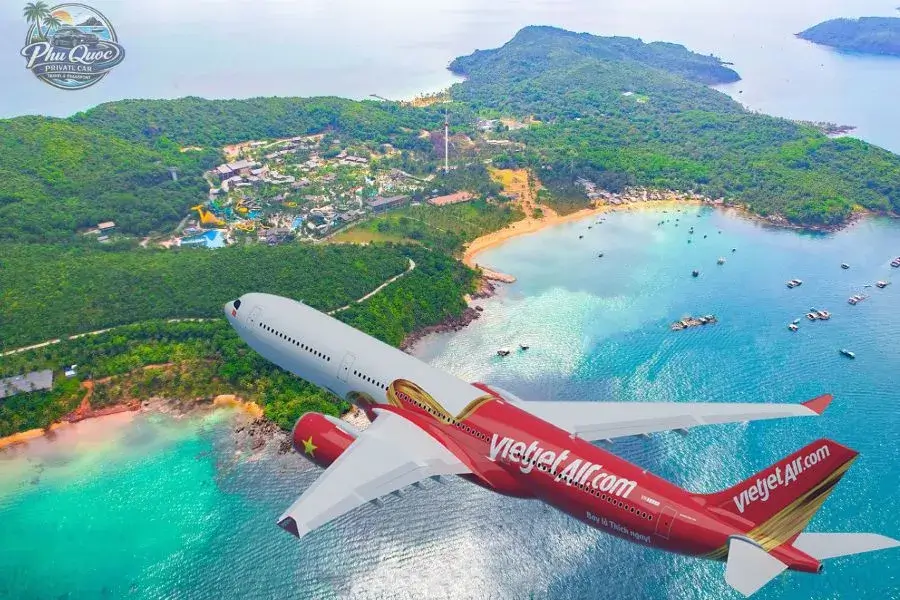
Flight Durations and Domestic Terminal Reality
The actual time spent airborne is a swift 55 to 60 minutes. However, first-time travelers frequently underestimate Saigon’s gridlock. Reaching the domestic terminal at Tan Son Nhat (SGN) from District 1 or District 3 during peak rush hours (8:00 AM – 10:00 AM and 4:30 PM – 7:00 PM) can easily consume an hour.
Always budget a strict 2-hour buffer prior to your flight departure. Once you arrive on the island, clear the terminal, and utilize our detailed Airport arrival guide to coordinate your ground pickup, you will be on the sand within 20 to 40 minutes.
Airline Landscape and Booking Strategy
The Ho Chi Minh City to Phu Quoc corridor is heavily serviced by domestic carriers operating mainline commercial jets:
- Vietnam Airlines: The national full-service carrier. It is the smartest option for families and luxury travelers because standard economy tickets automatically bundle generous checked baggage limits.
- VietJet Air: The optimal choice if you are researching how to get Phu Quoc from Ho Chi Minh on a tight budget. They offer ultra-cheap promotional fares, but be warned: gate agents strictly weigh carry-on items. If your bag crosses the 7kg threshold, you will face steep airport penalty fees.
- Vietravel Airlines & Bamboo Airways: Both handle reliable, high-frequency seasonal jet schedules along this trunk route.
Local Expert Booking Rule:
- During the peak dry winter window (November to March), book your flights a minimum of 45 days in advance.
- If you plan to travel during the Lunar New Year (Tet Holiday), flights must be booked 3 to 4 months out, as domestic tickets sell out completely and prices triple overnight.

Onward Transit: Phu Quoc Airport (PQC) to Your Resort
Phu Quoc International Airport is centrally located. Avoid unlicensed independent drivers who solicit travelers inside the terminal corridors. Instead, walk directly outside to the designated taxi lanes.
- Duong Dong Town (Center): 15 minutes via taxi.
- Ong Lang Beach (North-West): 25 minutes via taxi.
- Khem Beach / Sunset Town (South): 35 to 45 minutes via taxi.
For the most reliable, transparently priced ground experience, download the Xanh SM app to hail an official electric taxi, or use standard Grab services. If you are staying at a premium resort along Long Beach or Khem Beach, always check if a complimentary airport shuttle is bundled with your booking.
If you need a more private transfer service with expert drivers, you may want to book our personal car rental trips. We take tourists from Phu Quoc Airport to any hotel on the island, such as:
- Phu Quoc Airport To Vinpearl Resort By Private Car – 28 USD/sedan
- Phu Quoc Airport To Regent Phu Quoc By Private Car – 24 USD/sedan
- Phu Quoc Airport To Salinda Resort Private Car – 12 USD/sedan
- Phu Quoc Airport To Pullman Beach Resort – 16 USD/sedan
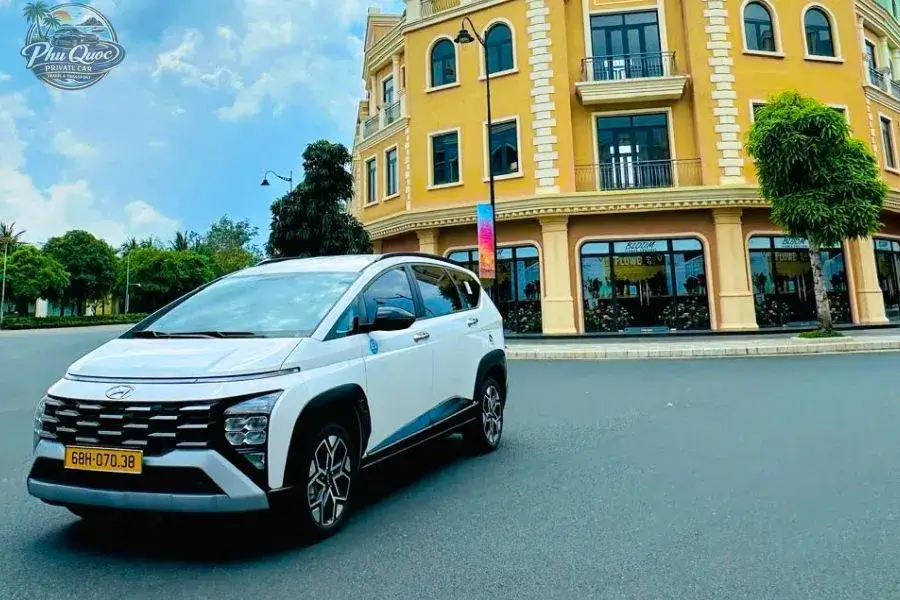
Taking a Bus and Ferry via the Mekong Delta
If you are a solo traveler, a digital nomad, or arriving from neighboring regions, perhaps mapping out an international itinerary via our Cambodia to Phu Quoc guide, the overland journey through southern Vietnam is a beautiful, culturally rich alternative.
Your trip begins by booking an interprovincial bus from the Mien Tay (Western) Bus Station in Saigon down to one of two springboard ports in Kien Giang Province.

The Rach Gia Route vs. The Ha Tien Route
Understanding the operational differences between these two ports will save you a massive headache:
#1 The Rach Gia Port (The Local Favorite):
The highway distance from Saigon to Rach Gia is shorter and faster (5 to 6 hours). A seasoned local traveler will book a midnight sleeper bus (operated by reputable companies like Phuong Trang / Futa Bus Lines or Kumho Samco), sleep through the night, arrive at the Rach Gia port at 5:00 AM, and step directly onto the earliest 7:00 AM high-speed ferry. The ferry crossing from Rach Gia to the island takes 2.5 hours.

#2 The Ha Tien Port (The Seasick Safe Haven):
Ha Tien sits right on the Cambodian border, requiring a significantly longer, rougher bus ride from Saigon (7 to 8 hours). However, because Ha Tien is geographically closer to Phu Quoc, the high-speed boat crossing is sliced down to a brief, smooth 75 minutes. Choose this option if you are highly vulnerable to motion sickness and want to minimize your time on open water.
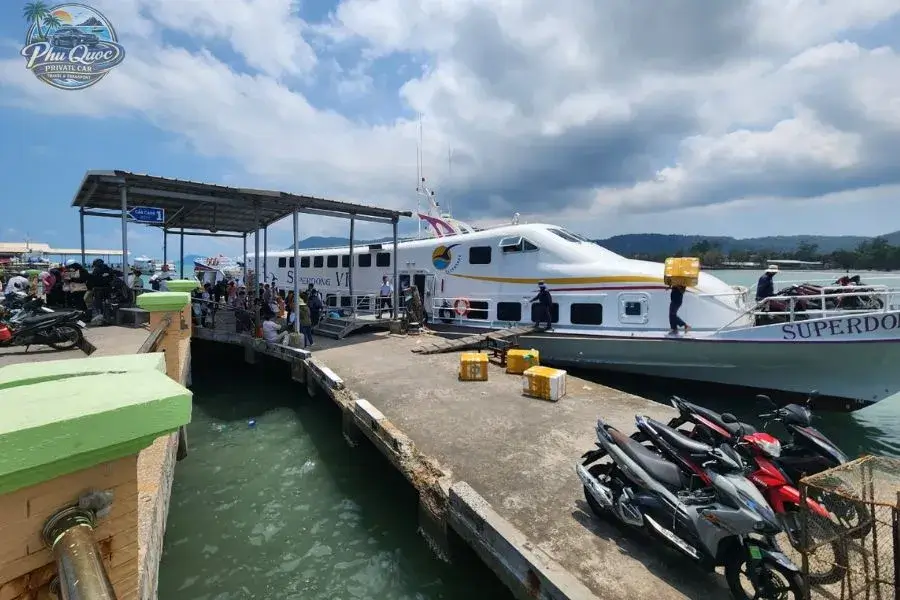
Local Tips for a Smooth Sea Crossing
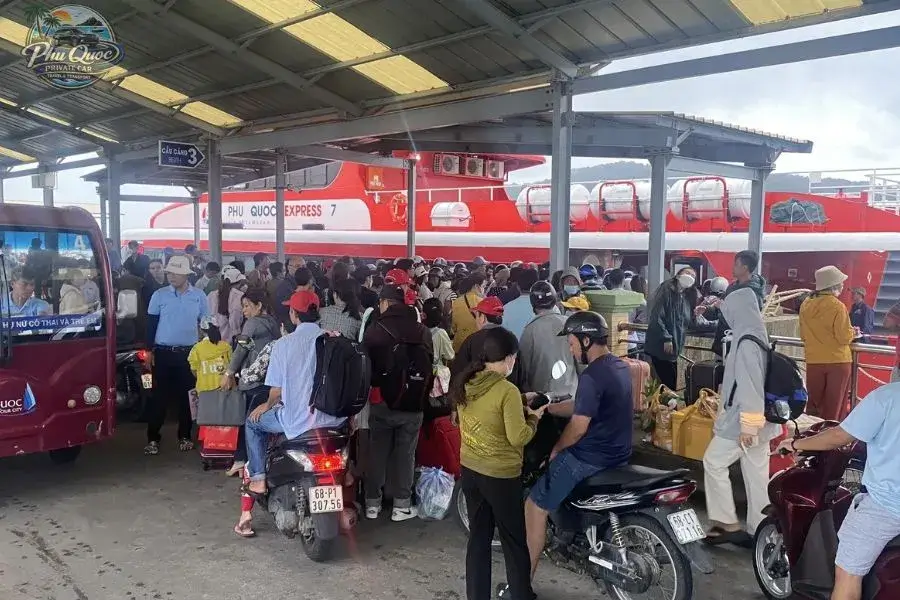
Stick to the top-tier maritime operators: Phu Quoc Express (highly recommended for their stable, red double-hulled eco-catamarans that cut smoothly through waves) or Superdong.
If you are traveling with large, rigid, hard-shell suitcases, reconsider this route because:
- High-speed ferries feature narrow passenger aisles.
- Massive bags are manually hoisted and stacked on the exposed rear decks, leaving them vulnerable to saltwater spray during choppy crossings.
Keep your passport, electronics, and valuables in a compact daypack at your seat.
Private Car & Motorcycle Realities
A rising number of road-trippers search for phrases like Phu Quoc how to get there from Ho Chi Minh, hoping to drive themselves. While a highway road trip down south sounds alluring, it requires specific maritime planning:
Motorbikes: This is incredibly easy. You can ride your motorbike from Saigon down to either port, purchase an additional vehicle ticket at the pier, and the crew will manually wheel your bike up a narrow gangplank onto the passenger ferry. Once you land at Bai Vong Port on the island, you have instant, independent wheels.
Private Cars: You cannot put a private car on a standard high-speed catamaran ferry. If you are driving a car, you must navigate all the way to the Ha Tien Port and book the specialized, slow-moving Thanh Thoi Car Ferry (Phà ). This massive vessel accommodates multi-ton trucks and cars, taking roughly 2.5 to 3 hours to cross the sea. Because of the long driving distance to Ha Tien and the slow ferry speeds, driving a car from Saigon consumes a minimum of 11 to 12 hours of pure travel.
Critical Truths Travelers Often Overlook
#1 Monsoon Weather and Maritime Lockdowns
From May to October, the southwest monsoon hits the Gulf of Thailand. While commercial jets utilize modern instrument landing systems to touch down safely during heavy downpours, the Maritime Administration enforces a zero-tolerance safety policy for boats.
If sea swells cross safety thresholds, all ferries out of Rach Gia and Ha Tien are subjected to immediate, unannounced groundings. If you choose the overland route in August or September, always build a 24-hour buffer day into your calendar in case you get temporarily stranded on the mainland.
#2 The Illusion of “Cheaper” Travel
Do the complete math before choosing the overland route solely to save cash. Once you combine the price of a premium sleeper bus ticket, the ferry ticket, terminal transfer taxis, and meals along the highway, the total cost matches or exceeds a promotional economy flight booked via a comprehensive Phu Quoc travel guide layout.
The Total Cost Discrepancy Formula: To debunk the myth of “cheap” ferry travel, it showcased a local math breakdown:
Overland Cost = Sleeper Bus Ticket + Ferry Ticket + Two Terminal Taxi Transfers + Roadside Meals
When visualized this way, the total often matches or exceeds a 900,000 VND promotional flight ticket from VietJet Air booked a month out.
Only choose the bus and ferry if you genuinely want to slow down and explore the towns of the Mekong Delta.
FAQs
Is there a train operating from Ho Chi Minh City down to the ferry ports?
No. The national North-South railway network terminates completely at Saigon Station (Ga Sài Gòn) in District 3. There is absolutely no rail infrastructure extending into the Mekong Delta region.
Where do the ferries dock on the island, and how do I get to my hotel?
Virtually all passenger high-speed ferries from both Rach Gia and Ha Tien dock at Bai Vong Port, situated on the eastern coast of the island. The port area is packed with arrival options. Shuttle buses connect the port directly to Duong Dong town for a small fee, while official metered taxis wait at the pier exit.
Can I rent a car or motorbike easily on the island instead of bringing one?
Yes, and it is highly recommended. Motorbike rentals are widely available across Duong Dong for roughly 120,000 to 150,000 VND per day. Car rentals typically come with a local driver included, which eliminates the logistical headache of navigating unfamiliar island roads and handling maritime transport.
Final Thoughts
Savoring the perfect Phu Quoc journey comes down to respecting your own travel style. If you have limited vacation days and want to maximize your time floating in the turquoise waters of Starfish Beach, save yourself the physical exhaustion and secure a direct flight.
If you view travel as a collection of unfiltered roadside moments, the midnight sleeper bus through the fruit orchards of the Delta and across the sea is an unforgettable Vietnamese backpacking rite of passage.
Thank you deeply for reading our guide. Phu Quoc Private Car team wishes you clear skies, smooth seas, and an incredible island escape.
Safe travels, and enjoy every sunset!